
Kandiyohi County Public Court Calendar
A court docket is the working list of case events. For Kandiyohi County, that may mean the public daily calendar posted by the Minnesota Judicial Branch, a hearing entry found through MCRO Hearing Search, or the Register of Actions inside a case file. The daily calendar is the fastest public way to see many hearings set for a court day, while the Register of Actions is better for past filings and case events.
Kandiyohi County District Court is the local venue for civil, family, probate, juvenile, criminal, and traffic cases filed in the county. Because Minnesota uses a unified District Court system, there is no separate local municipal docket or justice court docket to search for these records. City prosecution may exist for some misdemeanors, but the court event still belongs to District Court once the case is filed.
The official Kandiyohi County District Court page links to the public court calendar.
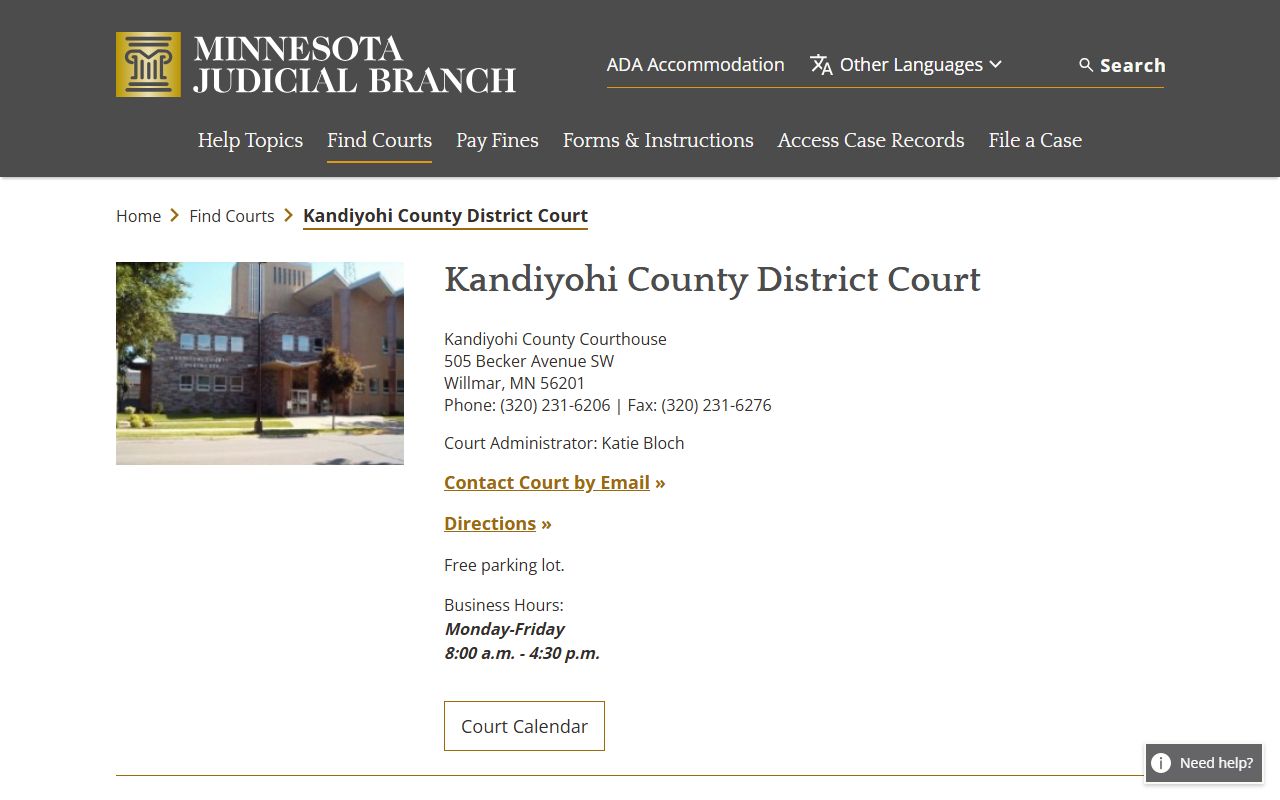
The court page is important because it ties the calendar, courthouse contact information, jurisdiction statement, and court-administration fallback to one official source.
How to Find Kandiyohi Dockets
The public daily calendar is posted at 7:00 a.m. each business day and updated hourly. It is useful for same-day or near-term hearings, but it does not include every matter. Printed calendars outside courtrooms or in public lobbies contain the most current daily information, so a person with a court appearance should not treat a web result as the last word.
- Check the Kandiyohi County public court calendar for daily hearing rows.
- Use MCRO Hearing Search by name, case number, judicial officer, or attorney for scheduled hearing information.
- Use MCRO Case Search by case number to open the Register of Actions for more case history.
- Call court administration if a hearing is urgent, missing from remote access, or unclear.
- Use courthouse posted calendars on the day of appearance because courtroom and schedule changes can occur.
Calendar rows may show no room or connection type for some entries. That is not proof that the hearing is cancelled. It may mean the hearing is remote, restricted, not fully posted, or still subject to local scheduling updates.
Kandiyohi Docket Entry Fields
The Kandiyohi public calendar PDF inspected during research showed a consistent set of visible fields. These fields help identify the case, hearing, courtroom, and judicial officer, but they do not replace the full case record. A full case search may be needed to see filings, orders, charge dispositions, judgment entries, or public documents.
| Field | What It Shows |
|---|---|
| Party Name | The listed party for the hearing, often the defendant, plaintiff, petitioner, or respondent. |
| Hearing Location | Courtroom 205, 209, 210, or another posted location or blank entry. |
| Hearing Date Time | The scheduled date and time for the court event. |
| Judicial Officer | The judge or judicial officer assigned to the hearing row. |
| Hearing Type | Examples include arraignment, motion hearing, settlement conference, Rule 8 appearance, and court trial. |
| Connection Type | In-person, remote, blank, or another posted access type when the calendar displays it. |
| Case Number | Local case numbers such as `34-CR-25-488`, `34-CV-26-240`, or `34-VB-26-411`. |
The official courthouse history page is an image source for Kandiyohi County court dockets.
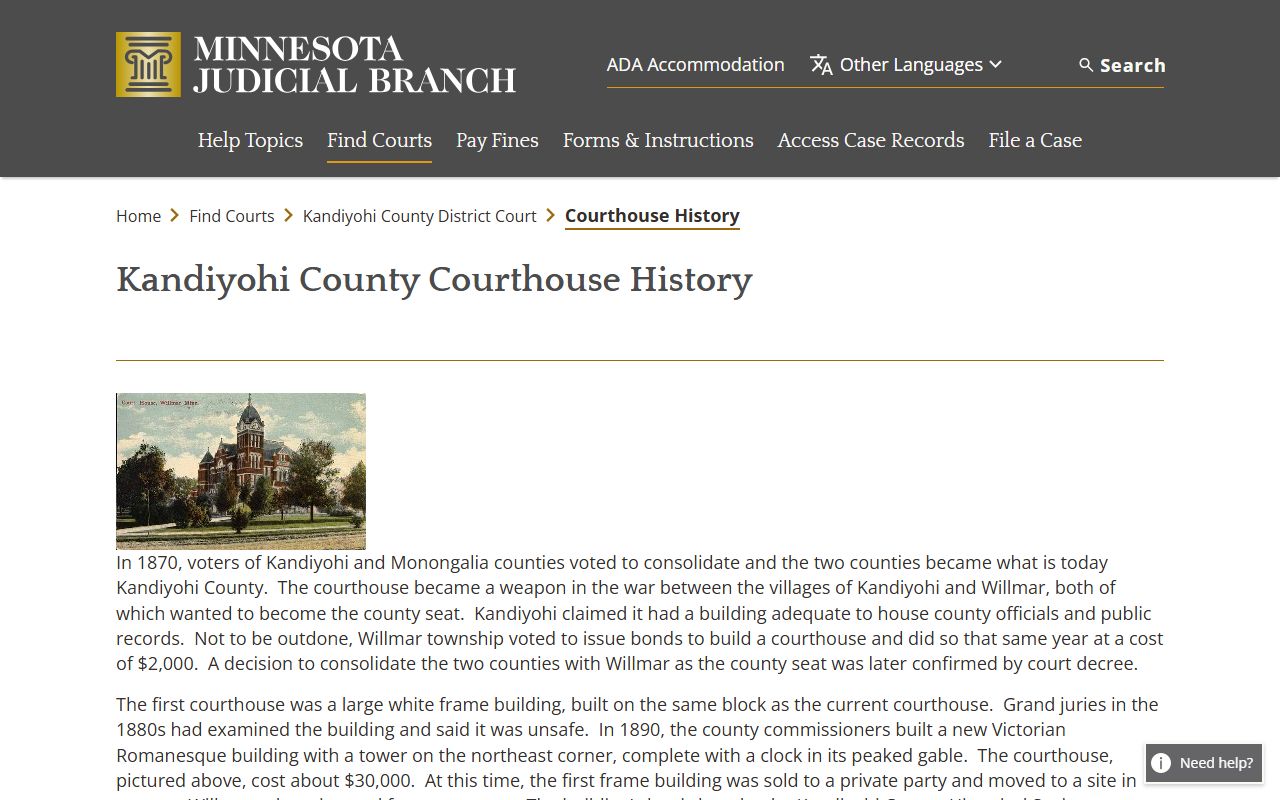
The history source is not a docket, but it anchors the local court location and explains why the Willmar courthouse is the public records venue.
Courts That Publish Kandiyohi Dockets
Kandiyohi County docket searching is simpler than in states with many lower court systems. The local docket source is Kandiyohi County District Court. Appeals move to Minnesota appellate courts, and federal cases move through federal court systems, but ordinary county criminal, civil, traffic, family, probate, and juvenile matters begin at the District Court level.
The Eighth Judicial District administration office provides district-wide administration, but it is not the hearing counter for a Kandiyohi County case. Case-specific docket questions should go to the Kandiyohi court location or to the statewide MCRO tools. That distinction matters when a person sees the phrase Eighth Judicial District on a court page and assumes there is a separate regional docket to search.
- Kandiyohi County District Court publishes the daily public court calendar and is the local source for District Court hearing questions.
- MCRO Hearing Search provides statewide district court hearing search by name, case number, judicial officer, attorney name, or attorney bar number.
- MCRO Case Search supplies docket-like Register of Actions entries for public cases that can be displayed online.
- Minnesota Court of Appeals and Minnesota Supreme Court records are separate appellate paths, not county daily calendars.
- Federal dockets use federal court systems and PACER, not the Kandiyohi County District Court calendar.
Because juvenile, domestic abuse, harassment, and civil commitment material can be restricted, some docket events may not appear remotely. That limit is a public-access rule issue, not a sign that court staff failed to post a normal docket row.
Federal docket paths are separate. A federal criminal, bankruptcy, immigration-related detention issue, or federal civil case will not appear as a Kandiyohi County District Court docket just because the person lives in the county or is held locally. Federal District of Minnesota cases use federal court systems, bankruptcy cases use the U.S. Bankruptcy Court for the District of Minnesota, and federal appeals use the Eighth Circuit.
Docket vs. Full Case Record
A docket is best for tracking movement. A full case record is better for substance. If the question is when a hearing happens, who the judicial officer is, or whether a case has an upcoming event, the docket or hearing search may answer it. If the question is what was filed, whether an order was signed, which charges were amended, or what sentence was imposed, the case file is the better source.
| Docket or Calendar | Full Case Record | |
|---|---|---|
| Format | Rows of hearings or chronological entries. | Case details, Register of Actions, documents, orders, and financial entries. |
| Best Use | Track dates, courtroom, hearing type, and judge. | Review filings, dispositions, judgments, public documents, and sentence details. |
| Access | Often free online, but not complete for all case types. | Some online records, courthouse terminal records, and certified-copy requests. |
| Limits | May omit confidential and non-remote matters. | May include restricted documents or material only court staff can release. |
Note: A same-day court appearance should be confirmed with printed courthouse calendars or court administration when the online entry is unclear.
Reading Kandiyohi Court Dockets
Case numbers carry local context. The `34` prefix identifies Kandiyohi County in the Minnesota court numbering format. The middle letters identify the case category. `CR` is criminal, `CV` is civil, `CO` is conciliation, `JV` is juvenile, and `VB` is traffic or violations bureau. The year and sequence number help distinguish cases filed in the same category.
Observed hearing types from the public calendar included Motion Hearing, Arraignment, Settlement Conference, Order to Show Cause Hearing, Conciliation Hearing, First Appearance, Review Hearing, Violation Hearing, Initial Appearance - Rule 8, Court Trial, and Permanency Progress Review Hearing. These labels tell what kind of event is scheduled. They do not show the final outcome by themselves.
Some hearing labels are easy to misread. An arraignment or first appearance is early in a criminal case and does not mean the defendant has been convicted. A motion hearing usually means the court will hear a request from one side. A settlement conference is often used to narrow issues or resolve a civil or family matter. A violation hearing can follow an alleged breach of probation, sentence terms, or release conditions.
The judicial officer field should also be read as a scheduling field, not a final outcome. Calendar examples identified Amy J. Doll, John P. Fitzgerald, Stephen J. Wentzell, and Allison T. Whalen. A listed judicial officer tells who is assigned to that event. It does not reveal the ruling, sentence, or final disposition. The case detail or certified record is needed for that.
For federal appellate docket context, the assigned manifest includes the PACER CM/ECF lookup for the Eighth Circuit.
Federal appellate PACER is relevant only after a federal case reaches the Eighth Circuit, not for local Kandiyohi County District Court hearings.
Access channels for docket work include the daily calendar, MCRO Hearing Search, MCRO Case Search, courthouse posted calendars, and court administration at (320) 231-6206. The court calendar PDF is public and searchable, but the official court page warns that calendars do not include all matters. Confidential and non-remotely-accessible cases are not posted.
For a person appearing in court, the safest sequence is to check the online calendar before travel, use the courthouse address rather than the jail or Recorder address, review the printed lobby calendar after arrival, and ask court administration if the room, remote connection, or case number does not match. The official court page notes free parking and links to remote hearing, language access, jury service, fees, and the Eighth Judicial District. Those resources support docket use without changing the docket itself.
Dockets also differ from warrant and jail data. A missed hearing may later produce a warrant, and a jail roster may show a person in custody on a charge, but neither source replaces the court docket. The docket remains the court schedule and case-event record. The Sheriff source should be used for active warrants and custody status, while District Court and MCRO remain the court-hearing sources.